
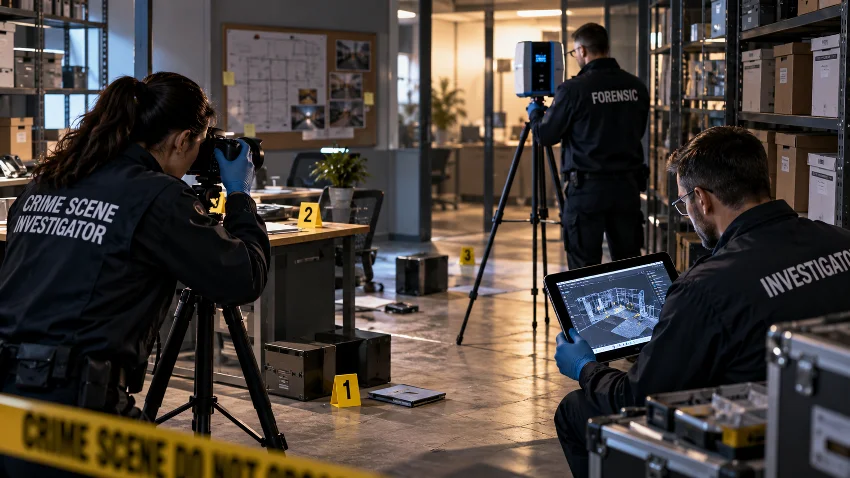
Solving a complex criminal case requires much more than following suspicious clues or collecting physical evidence. Behind every reliable finding is a careful process involving scientific examination, investigative reasoning, legal safeguards, and professional judgment.
Modern Criminal Investigation combines forensic technology with established legal procedures to reconstruct events, evaluate competing explanations, and determine whether available evidence supports criminal allegations. As digital information becomes increasingly important, investigators must also address new questions about privacy, reliability, and scientific accuracy.
This comprehensive guide explores advanced forensic methods, evidence management, investigative techniques, and legal principles that shape effective criminal justice practices.
1. Understanding Modern Criminal Investigation and Its Core Principles
Contemporary investigative practice combines scientific methods, legal knowledge, analytical thinking, and ethical decision-making.
Its purpose is not simply to identify a suspect. A reliable investigation establishes relevant facts, considers alternative explanations, and develops evidence that can withstand independent examination.
This distinction is particularly important because early assumptions can influence how investigators interpret later information.
Developing an Evidence-Based Investigative Framework
Evidence-based investigations begin with clearly defined questions rather than predetermined conclusions.
Investigators examine what is known, what remains uncertain, and which additional information could distinguish competing explanations.
For example, consider a commercial burglary involving a damaged entrance, missing equipment, and conflicting witness accounts.
Investigators might initially consider unauthorized entry, employee involvement, or a staged incident intended to conceal another event.
Each explanation should be evaluated against independently obtained information.
The objective is to identify the explanation best supported by reliable evidence, not the one that seems most convincing during preliminary discussions.
Applying Scientific Reasoning to Criminal Cases
Scientific reasoning requires observations to be distinguished from interpretations.
A fingerprint recovered from a surface is an observation. The conclusion that a particular person committed a crime is a much broader inference requiring additional support.
The presence of biological material, for instance, may establish an association between a person and an object without revealing when or why contact occurred.
Investigators must consider contextual information, alternative transfer mechanisms, and the limitations of available tests.
This analytical discipline helps reduce confirmation bias and premature conclusions.
Balancing Investigative Effectiveness With Individual Rights
Investigative authority exists within legal boundaries.
Rules governing searches, seizures, arrests, questioning, and access to private information differ between jurisdictions.
In the United States, constitutional protections and applicable federal or state laws influence many investigative decisions.
A technically sophisticated examination may become legally problematic if the evidence was obtained unlawfully.
Professional investigators therefore coordinate investigative objectives with legal requirements from the earliest stages of a case.
2. Advanced Crime Scene Examination and Evidence Preservation
Crime scenes contain information that may become impossible to recover once the environment changes.
Effective scene management emphasizes safety, accurate documentation, evidence integrity, and systematic examination.
The National Institute of Justice’s Crime Scene Investigation: A Guide for Law Enforcement provides an established framework for initial response, scene evaluation, processing, and documentation.
Establishing a Reliable Crime Scene Workflow
The first priority is addressing immediate threats and ensuring that emergency medical needs receive appropriate attention.
Once the environment is safe, authorized personnel establish controlled access and document relevant conditions.
Recording the original scene is essential because objects may need to be moved during lawful examination or emergency response.
Investigators can use photography, written descriptions, diagrams, and other documentation methods to capture spatial relationships.
For example, documenting the position of damaged furniture relative to nearby doors may help specialists assess possible event sequences.
However, scene reconstruction should remain provisional until supporting evidence has been evaluated.
Maintaining Chain of Custody
Chain of custody refers to the documented history of how evidence is collected, transferred, stored, examined, and presented.
This record helps establish that an item examined in a laboratory is reasonably identifiable as the item originally recovered.
Documentation typically addresses who handled the evidence, when transfers occurred, and the purposes of those transfers.
A missing entry does not necessarily make evidence automatically inadmissible, but it can create questions about authenticity, reliability, or potential alteration.
Consider a biological sample collected during a homicide investigation.
Its evidentiary value depends not only on laboratory findings but also on confidence that the sample was properly identified and preserved.
Consistent documentation strengthens transparency throughout the process.
Using Modern Scene Documentation Technologies
Digital photography, three-dimensional scanning, and spatial measurement systems can improve the quality of scene records.
Three-dimensional imaging may allow specialists to revisit spatial relationships without physically returning to the original location.
These methods can support courtroom illustrations and reconstruction analysis.
Nevertheless, advanced equipment introduces additional responsibilities.
Investigators must understand measurement uncertainty, calibration requirements, and the limitations of generated models.
A detailed digital reconstruction should not be mistaken for an exact representation of everything that occurred.
Technology provides analytical support, while conclusions still depend on credible evidence and defensible reasoning.
3. Applying Advanced Forensic Science and Laboratory Methods
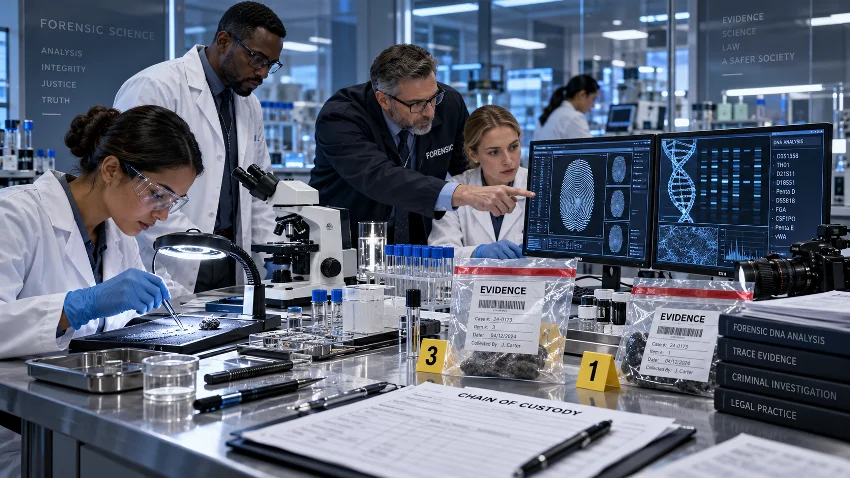
Forensic science examines physical and digital materials to answer questions relevant to legal proceedings.
Different disciplines investigate different forms of evidence, and their reliability depends on the underlying methods, validation studies, and quality controls.
An important principle is that no technique should be considered infallible merely because it appears scientific.
DNA Profiling and Biological Evidence Interpretation
DNA analysis has transformed forensic identification by allowing biological materials to be compared using genetic markers.
Short tandem repeat profiling examines selected regions of DNA where repeat patterns vary between individuals.
Laboratories can use these patterns to evaluate whether a person may be a contributor to a biological sample.
The National Institute of Justice explains that DNA examinations involve sample processing, genetic analysis, comparison, and interpretation.
However, identifying a potential contributor is not equivalent to proving criminal involvement.
DNA may have been deposited before an event, transferred indirectly, or recovered from a mixed sample containing material from multiple individuals.
Interpreting complex mixtures requires validated analytical methods and careful consideration of uncertainty.
Statistical results should also be communicated accurately.
A random match probability, for example, is not the same as the probability that a particular defendant is innocent.
Confusing these concepts can seriously distort the meaning of scientific evidence.
Fingerprint and Trace Evidence Examination
Friction ridge impressions can provide valuable identifying information when sufficient detail is available.
However, latent prints may be incomplete, distorted, or affected by the surfaces on which they were deposited.
Examiners should document relevant limitations and follow validated procedures.
Trace evidence presents different challenges.
Fibers, glass fragments, paint particles, and other small materials may help establish associations between objects, people, or locations.
Suppose investigators recover glass fragments from clothing following a suspected forced-entry incident.
A laboratory comparison might determine whether the fragments are consistent with glass from a particular broken window.
Yet consistency does not necessarily establish exclusive origin.
The strength of an association depends on the characteristics examined and the possibility of alternative sources.
Forensic Quality Standards and Scientific Reliability
The National Academies’ 2009 report Strengthening Forensic Science in the United States: A Path Forward raised important concerns about scientific validation, consistency, and the interpretation of forensic evidence.
These issues remain central to modern forensic quality assurance.
NIST’s Organization of Scientific Area Committees for Forensic Science maintains a registry of standards intended to promote reliable and reproducible forensic work.
Laboratories should use appropriate validated methods, quality controls, competency assessments, and documented reporting procedures.
Scientific confidence depends on demonstrable methodological performance rather than professional experience alone.
4. Investigating Digital Evidence and Cyber-Related Crime
Digital evidence now appears in many investigations that do not initially involve cybercrime.
Mobile devices, online accounts, security systems, cloud services, and electronic communications may contain information relevant to timelines and relationships.
However, digital records require specialist interpretation.
Understanding Digital Forensic Evidence
Digital forensics concerns the lawful identification, preservation, examination, and interpretation of electronically stored information.
Potential evidence may include communication records, device activity, documents, photographs, and application-generated data.
The NIJ’s Electronic Crime Scene Investigation: A Guide for First Responders emphasizes the importance of recognizing, documenting, and safeguarding electronic evidence.
Unlike some physical objects, digital information may change through ordinary system processes.
This makes documentation of collection conditions and preservation methods particularly important.
Specialists may verify forensic copies through cryptographic hash values, which help detect whether data has changed.
A matching hash supports data integrity but does not independently establish the truth of the information contained in the file.
Reconstructing Events Through Digital Timelines
Digital investigations frequently involve comparing records from multiple sources.
For example, investigators might examine lawfully obtained communications, entry-system records, and security footage when assessing the timing of a reported incident.
However, timestamps do not always represent the same time zone or event type.
Some systems record when information was created, while others reflect modification, receipt, or synchronization.
These distinctions can affect interpretations.
A rigorous timeline identifies the source of each event, relevant technical uncertainties, and any gaps in available information.
Investigators should avoid presenting approximate digital timelines as unquestionably precise.
Addressing Cloud Evidence and Privacy
Cloud-based services create additional investigative challenges because relevant data may be stored across different systems or jurisdictions.
Access may require judicial authorization, legal process directed to a service provider, or another lawful basis.
Cross-border requests can involve different privacy laws and international cooperation procedures.
Investigators should consider proportionality and avoid collecting unrelated personal information unnecessarily.
A reliable process must protect evidentiary integrity while respecting applicable legal safeguards.
5. Improving Investigative Interviewing and Witness Evaluation
Witness interviews remain essential even when substantial scientific evidence is available.
People may provide information about activities, relationships, sounds, events, or observations that technological systems did not capture.
Yet human memory is reconstructive rather than a perfect recording.
Investigators must therefore consider how questioning practices influence the accuracy of information obtained.
Using Non-Coercive Interviewing Techniques
Effective investigative interviews encourage individuals to describe events in their own words.
Open-ended questions generally allow witnesses to explain what they recall without being directed toward a particular answer.
For example, asking a witness to describe what happened after entering a building provides more room for independent recollection than a question that assumes a particular suspect was present.
Investigators can then seek clarification about chronology, locations, and uncertainties.
Respectful communication and clear documentation improve the transparency of the process.
Coercion, intimidation, or inappropriate promises can undermine the reliability of statements and raise serious legal concerns.
Understanding Eyewitness Identification Limitations
Eyewitness identification can be powerful, but confidence and accuracy are not interchangeable.
Memory may be affected by viewing conditions, stress, the passage of time, and information encountered after an event.
The NIJ’s Eyewitness Evidence: A Guide for Law Enforcement discusses systematic procedures for interviewing witnesses and documenting identification activities.
Fair procedures seek to avoid unnecessary suggestion.
Investigators should also document witness descriptions and relevant circumstances before subsequent identification activities potentially influence recollection.
Evaluating Statements Against Independent Evidence
A witness account should be assessed alongside other reliable information.
Inconsistencies may reflect imperfect memory, misunderstandings, differences in perception, or deliberate deception.
Investigators should not assume that every discrepancy indicates dishonesty.
Suppose two witnesses provide different estimates of the time a vehicle left a location.
Instead of immediately rejecting one account, investigators could assess the witnesses’ opportunities to observe the event and compare their estimates with independently documented records.
This approach encourages balanced evaluation and reduces unnecessary reliance on subjective impressions.
6. Understanding Criminal Procedure and Evidence Admissibility
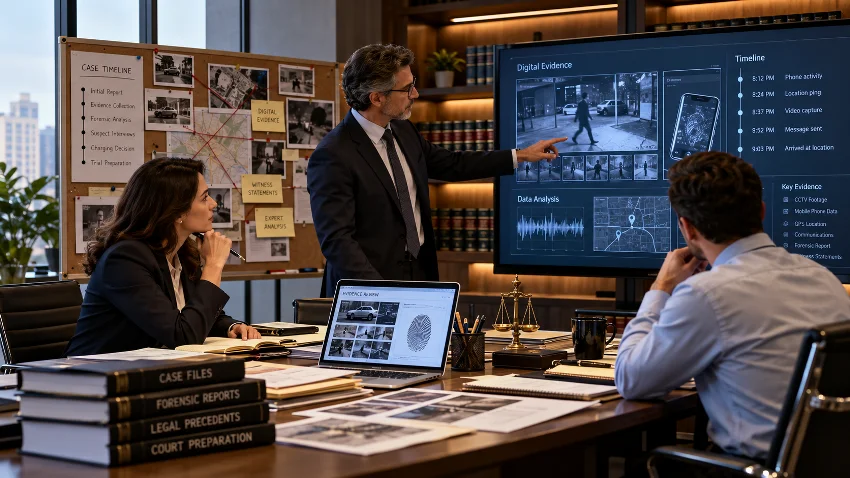
Forensic findings become legally meaningful through procedural rules governing how information is obtained, disclosed, challenged, and presented.
Investigators and forensic specialists must understand that scientific relevance does not automatically guarantee courtroom admissibility.
The applicable legal framework depends on jurisdiction and the nature of the proceeding.
Search Authority and Constitutional Safeguards
In the United States, the Fourth Amendment protects against unreasonable searches and seizures.
Search warrants are an important mechanism for authorizing investigative activity, although established legal exceptions and other lawful authorities may apply.
The scope of authorization matters.
Access to one category of information does not necessarily permit unrestricted examination of unrelated materials.
Investigators should consult applicable legal standards and obtain appropriate authorization before conducting intrusive examinations.
Failure to comply can create evidentiary challenges and undermine public confidence.
Expert Testimony and Federal Rule of Evidence 702
Scientific witnesses may be asked to explain specialized findings to judges or juries.
Federal Rule of Evidence 702 governs expert testimony in U.S. federal proceedings.
Under the rule, the proponent must demonstrate that expert testimony satisfies applicable reliability requirements, including the reliability of the methods and their application to case facts.
The 2023 amendment clarified the court’s responsibility to assess whether the admissibility requirements have been established.
Experts must also avoid overstating the certainty of their conclusions.
A responsible forensic report explains relevant findings, methodological limitations, and the reasoning connecting observations to interpretations.
Clear communication is particularly important when statistical evidence or complex scientific techniques are involved.
Disclosure and Procedural Fairness
Fair proceedings depend on compliance with applicable disclosure obligations.
In U.S. criminal cases, constitutional requirements may obligate prosecutors to disclose material evidence favorable to the defense, alongside other discovery duties.
Investigators and prosecutors should preserve and communicate relevant information, including findings that may challenge an initial theory.
This responsibility supports accurate fact-finding.
A justice system cannot reliably evaluate competing explanations when significant information is withheld or ignored.
Procedural safeguards are therefore part of investigative quality, not obstacles separate from it.
7. Managing Complex Investigations and Interagency Collaboration
Major investigations often involve multiple professional disciplines.
Police investigators, forensic laboratories, prosecutors, medical examiners, and digital specialists may contribute different forms of expertise.
Coordination is essential, but each participant must also maintain appropriate professional independence.
Developing a Structured Case Management System
Complex cases generate substantial amounts of information.
Without an organized management framework, investigators may overlook relevant materials or duplicate efforts.
A structured case record should distinguish factual observations, witness accounts, scientific findings, investigative hypotheses, and unresolved questions.
This distinction helps teams understand which conclusions are supported and which still require verification.
Regular reviews can identify evidentiary gaps and determine whether the current investigation remains proportionate and justified.
Case management systems should also include appropriate access controls and audit records.
Improving Communication Between Specialists
Different professional disciplines use specialized terminology.
A laboratory report may contain technical qualifications that non-specialists misunderstand.
For example, a forensic scientist might describe a result as inconclusive.
That conclusion should not be converted into an assertion that the evidence supports a particular suspect merely because the broader case appears persuasive.
Clear communication requires specialists to explain both the significance and limitations of their findings.
Interdisciplinary discussions can improve investigative decisions when they preserve scientific independence and avoid pressuring examiners toward preferred outcomes.
Maintaining Ethical Accountability
Complex cases sometimes attract public attention or institutional pressure.
Investigators may face expectations to identify suspects quickly or provide definitive explanations before the evidence supports them.
Professional accountability requires resisting premature certainty.
Supervisors should encourage documented reasoning, meaningful review, and appropriate correction of mistakes.
An effective investigative culture treats the discovery of contradictory evidence as an opportunity to improve accuracy rather than a threat to an established narrative.
8. Integrating Emerging Forensic Technologies Responsibly
Scientific and technological developments continue to expand investigative possibilities.
Advanced analytical software, automated image processing, improved DNA techniques, and data integration platforms may support more efficient examinations.
However, innovation should be evaluated according to demonstrable reliability and lawful application.
Artificial Intelligence in Forensic Analysis
AI systems can help identify patterns in large datasets and support some forms of image or document analysis.
For example, appropriately validated software may assist specialists in organizing large collections of digital records.
Nevertheless, algorithmic outputs are not automatically reliable evidence.
Performance may vary across data quality, operating conditions, and population characteristics.
Institutions should examine validation studies, error rates, explainability, and potential bias before relying on automated conclusions.
Human oversight remains essential when analytical results may influence decisions affecting individual rights.
Advanced Genetic Analysis
Modern forensic genetics continues to develop methods for interpreting challenging biological samples.
Probabilistic genotyping can help specialists evaluate certain complex DNA mixtures using statistical models.
However, the validity of an interpretation depends on the specific software, assumptions, validation conditions, and sample characteristics.
Forensic genetic genealogy may also assist selected investigations where legally and ethically permitted.
Its use raises important questions about privacy, informed consent, database access, and the interests of genetic relatives.
Agencies should establish transparent safeguards and comply with applicable policies before using such approaches.
Strengthening Technological Governance
New technology should undergo formal assessment before operational deployment.
Institutions need to understand what a tool can accomplish, when its results become unreliable, and how its performance will be monitored.
Training and independent evaluation should accompany implementation.
Forensic units should also document software versions, methodological changes, and quality assurance outcomes.
Modernization is most valuable when it improves the transparency and defensibility of investigative findings.
9. Building a Reliable and Ethical Investigative Framework
Long-term investigative excellence depends on organizational systems as much as individual expertise.
Well-trained investigators still require appropriate supervision, reliable laboratory services, clear procedures, and opportunities for professional development.
A strong institutional framework connects scientific quality with legal accountability.
Creating Continuous Professional Development
Investigative techniques evolve as research identifies methodological limitations and new technologies become available.
Professionals should participate in regular training covering forensic interpretation, legal developments, interview practices, and evidence management.
Learning should extend beyond technical instruction.
Investigators also benefit from training in cognitive bias, critical reasoning, and the communication of uncertainty.
These capabilities help teams evaluate evidence more carefully under demanding conditions.
Conducting Independent Case Reviews
Independent review can identify weaknesses that investigators deeply involved in a case might overlook.
Reviewers may examine whether alternative explanations received appropriate consideration, whether forensic findings were communicated accurately, and whether relevant evidence was properly preserved.
Such reviews are particularly important when new information challenges earlier conclusions.
Institutions should establish clear procedures for correcting mistakes and communicating material changes to appropriate legal authorities.
Accountability protects the integrity of both investigations and subsequent proceedings.
Measuring Investigative Quality Beyond Case Closure
Clearance rates and processing times are useful operational indicators, but they cannot independently establish investigative quality.
A more balanced assessment may examine evidentiary reliability, procedural compliance, documentation standards, and the timeliness of appropriate disclosure.
Forensic laboratories can also monitor quality assurance results and staff competency.
Investigative agencies should evaluate whether policies promote fair treatment and careful decision-making.
The ultimate objective is not simply faster case resolution.
It is producing accurate, lawful, and transparent findings that support credible criminal justice outcomes.
Criminal Investigation excellence requires the careful integration of forensic science, digital evidence, investigative reasoning, and legal safeguards. Reliable outcomes depend on preserving evidence, validating analytical methods, documenting uncertainty, and protecting procedural fairness.
Investigators, legal professionals, and forensic specialists should continuously review their practices against established scientific and legal standards. Strengthening these foundations supports more accurate investigations, greater accountability, and public confidence in the justice system.
Expand your knowledge with this valuable resource featuring additional information and relevant discussions. Exploring supplementary references can help you discover new perspectives, understand important concepts, and connect related ideas. Take a closer look at the recommended content to continue learning beyond this article.
Get Mobile Prices ⭒ Router Linksys SmartWifi ⭒ Fikret Orman ⭒ The Northpole Bar ⭒ Single Smokers ⭒ Stromectol1h ⭒ Eclector ⭒ Keto Premiere ⭒ Atoz MP3 ⭒ Bside Rock ⭒ Investment Advice ⭒ Financial Planning ⭒ Budget Travel ⭒ Stocks & Crypto ⭒ Travel Cornwall ⭒ Home & Garden ⭒ Health & Wellness ⭒ Trading & Exchanges ⭒ Apps & OS ⭒ Mobile Gaming ⭒ Health & Well-Being ⭒ Asia Travel ⭒ Business Strategy ⭒ Health & Fitness ⭒ Photography ⭒ Music & Movie ⭒ Saving & Investing ⭒ Travel Guide ⭒ Virtual Reality & Extended Reality ⭒ Careers & Skills ⭒ Culinary Traditions & Flavors ⭒ Technology & AI ⭒ Virtual Reality & Video Games ⭒ Limpley Stoke Travel ⭒ Small Business Strategy ⭒ Photograpy & Digital Creator ⭒ Dakar Rally ⭒ Credit Card ⭒ Digital Marketing ⭒ Asia Travel ⭒ Movie & Entertainment ⭒ Business & Career ⭒ Gadget & Apps ⭒ Video Production ⭒ Insurance Guides ⭒ Financing ⭒ Annuities & Retirement ⭒ Business Strategy ⭒ Investment Strategies ⭒ Digital Marketing ⭒ Summer Style ⭒ Gadgets & Gear ⭒ Nature Travel ⭒ Retirement Income ⭒ Beauty & Style ⭒ Stock Market ⭒ Fantasy Movies ⭒ Career & Productivity ⭒ Science Education ⭒ iGaming Content ⭒ Astro Edu ⭒ Be Smart Edu ⭒ Biology ⭒ BMI Edu ⭒ Cent Edu ⭒ Chemistry Edu ⭒ Cholesterol Edu ⭒ Cooking Edu ⭒ Daily Edu ⭒ Dance Edu ⭒ Dental Edu ⭒ Diet Edu ⭒ Doctor Edu ⭒ Econom Edu ⭒ Engine Edu ⭒ Fashion Edu ⭒ Films.edu.pl ⭒ ForexForum Edu ⭒ Games Edu ⭒ Halkali Edu ⭒ Hazard Edu ⭒ HealthCollege Edu ⭒ Journal Edu ⭒ Kidsfun Edu ⭒ Kila Edu ⭒ Laws Edu ⭒ LetsTalk Edu ⭒ Life Edu ⭒ Lifestyle Edu ⭒ MakeupArt Edu ⭒ Mid Edu ⭒ Mil Edu ⭒ Natural Edu ⭒ Neural Edu ⭒ NeuroSoft Edu ⭒ Oak Edu ⭒ Olza Edu ⭒ Partner Edu ⭒ PatoLogia Edu ⭒ Philosophy Edu ⭒ Podcast Edu ⭒ Poker Edu ⭒ PolisHighschool Edu ⭒ Preceptor Edu ⭒ Promotor Edu ⭒ Psico Edu ⭒ Sena Edu ⭒ Social Edu ⭒ WebNet Edu ⭒ WF Edu ⭒ Work Edu ⭒ Nowa Edu ⭒ Sylva Edu ⭒ Study Edu ⭒ Slub Edu ⭒ Nus Edu ⭒ Unr Edu ⭒ Umd Edu ⭒ Upm Edu ⭒ Tell Edu ⭒ Vibes ⭒ Meetup ⭒ Discover ⭒ Daily ⭒ Creative ⭒ Style ⭒ Fairy ⭒ Likeable ⭒ Mindset ⭒ Future ⭒ Genz ⭒ Truly ⭒ Dreamy ⭒ Scope ⭒ Journey ⭒ Inspire ⭒ Growth ⭒ Rogue ⭒ Mint ⭒ Looks ⭒ Hub ⭒ Sight ⭒ Focus ⭒ Digest ⭒ Flow ⭒ Explore ⭒ Ideas ⭒ Stories ⭒ Wisdom ⭒ Vision ⭒ Ost ⭒ Mart ⭒ Pulse ⭒ Prime ⭒ Trend ⭒ Advice ⭒ Learn ⭒ Right ⭒ Wave ⭒ Nova ⭒ LifeSpace ⭒ Witrynki ⭒ Rsn ⭒ Igg ⭒ GoodStory ⭒ AdPoint ⭒ Lvs ⭒ GoRank ⭒ Budget ⭒ Muse ⭒ Viva ⭒ Cove ⭒ Cozy ⭒ Digi ⭒ Se ⭒ Caz ⭒ Erz ⭒ E-book ⭒ Total ⭒ War ⭒ Deko ⭒ Urbans ⭒ Citi ⭒ Kicks ⭒ Rings ⭒ Edus ⭒ Seeks ⭒ More ⭒ Reads ⭒ Finds ⭒ Words ⭒ Styled ⭒ Mivo ⭒ Jelio ⭒ Zavi ⭒ Inspiro ⭒ Stylio ⭒ Trips ⭒ Trave ⭒ Move ⭒ Lane ⭒ Theory ⭒ Mosaic ⭒ Locale ⭒ Essence ⭒ Virela ⭒ Laluna ⭒ Evina ⭒ Zevora ⭒ Kultur ⭒ Pins ⭒ Tick ⭒ Netter ⭒ Pops ⭒ Cosmo ⭒ Huge ⭒ Minds ⭒ Reds ⭒ Techs ⭒ Meds ⭒ Arts ⭒ Mobi ⭒ Zelo ⭒ Lifes ⭒ Piknik ⭒ Tripy ⭒ Fins ⭒ Deeps ⭒ Dots ⭒ Teen ⭒ Gens ⭒ Revo ⭒ Tekun ⭒ Hubs ⭒ Spotiva ⭒ Startiva ⭒ Inves ⭒ Biznex ⭒ Growin ⭒ Mufa